Vitaclaris

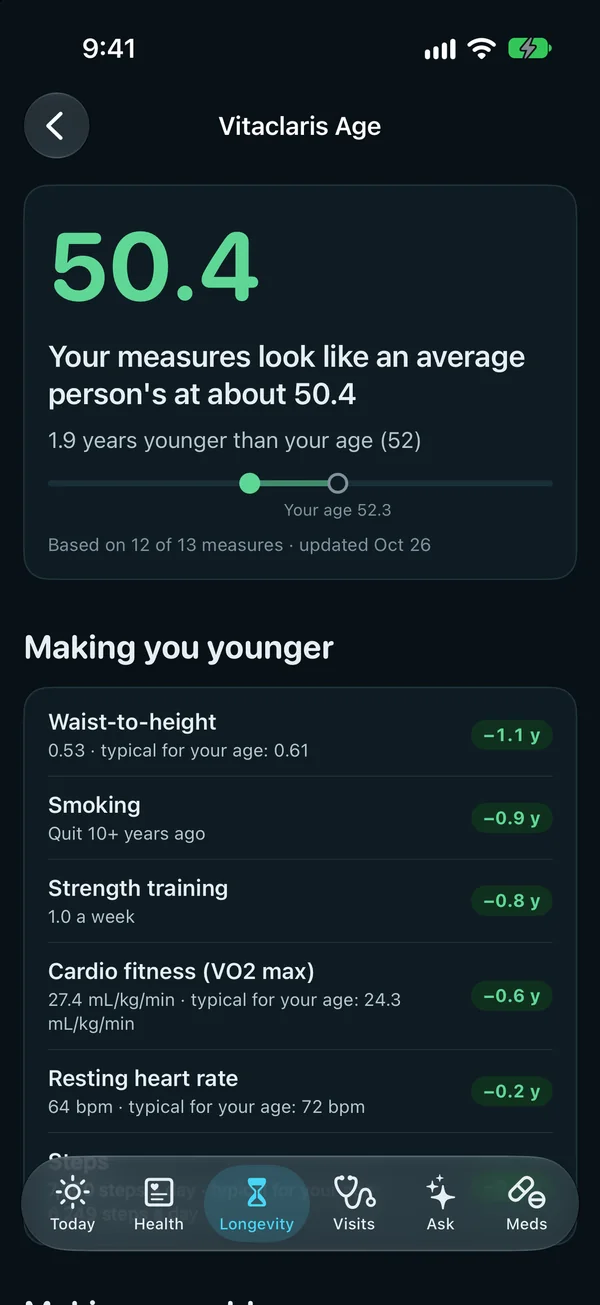
Your Vitaclaris Age
One number that says how your measures compare with people your age, and what would move it.
- From published studies Each measure is compared with what's typical for your age and sex, using the effect large studies found for it. Your Vitaclaris Age is the age whose typical measures match yours.
- Week by week It needs your year of birth and at least four measures, one of them about fitness. It's saved once a week, so it follows your habits, not one bad night.
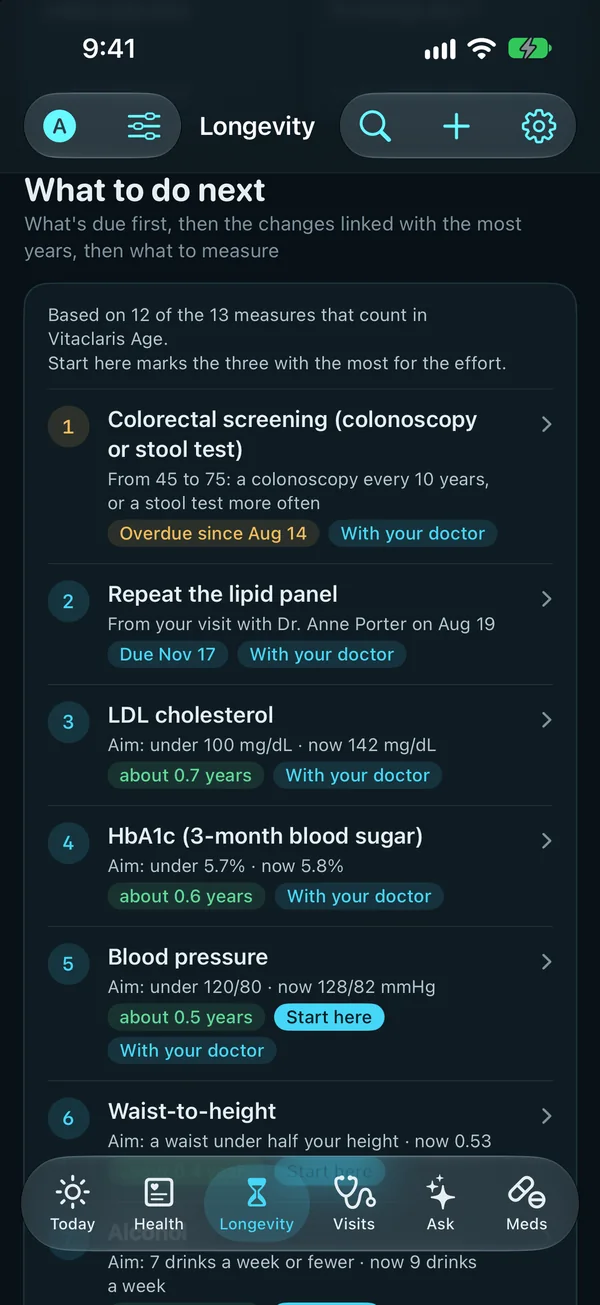
- What to do next One list: what's due from your plan, then the changes linked with the most years, from your own numbers (where you are now and what to aim for), then what to measure. Start here marks the three with the most for the effort.
Vitaclaris Age is an estimate, not a medical test. The studies observed people, so these are links, not promises: talk any change over with your doctor. Mind and Hearing are graded but don't count in the age. You can hide it at any time.
Eight areas that shape your healthspan
Each area is graded Good, Fair or Needs attention against public health guidelines, and takes the grade of its weakest key measure. So you always know what to work on first.
- Good
- Fair
- Needs attention
Heart
Cardio fitness, blood pressure, LDL (“bad”) cholesterol and heart rhythm, with resting heart rate and heart rate variability for information.
Metabolic
Long-term blood sugar (HbA1c), fasting blood sugar and waist-to-height, with triglycerides, HDL (“good”) cholesterol and kidney function.
Movement
Steps, exercise minutes, strength training, walking steadiness, one-leg balance and the 30-second chair stand.
Sleep
How long and how regularly you sleep, and breathing disturbances at night.
Mind
Mood and anxiety check-ins (9 and 7 questions) and your daily mood.
Nutrition
How Mediterranean your diet is (14 questions) and alcohol, with fiber and ultra-processed food from your food log.
Hearing
Hearing test results and everyday noise from your AirPods and Apple Watch.
Prevention
Smoking, and the screenings and vaccines due for your age and sex.
Graded against published guidelines: US heart and diabetes guidelines for blood pressure, cholesterol and blood sugar, the US Preventive Services Task Force's and the CDC's for screenings, and international guidance for hearing. Settings → Help → Medical sources in the app lists each one.
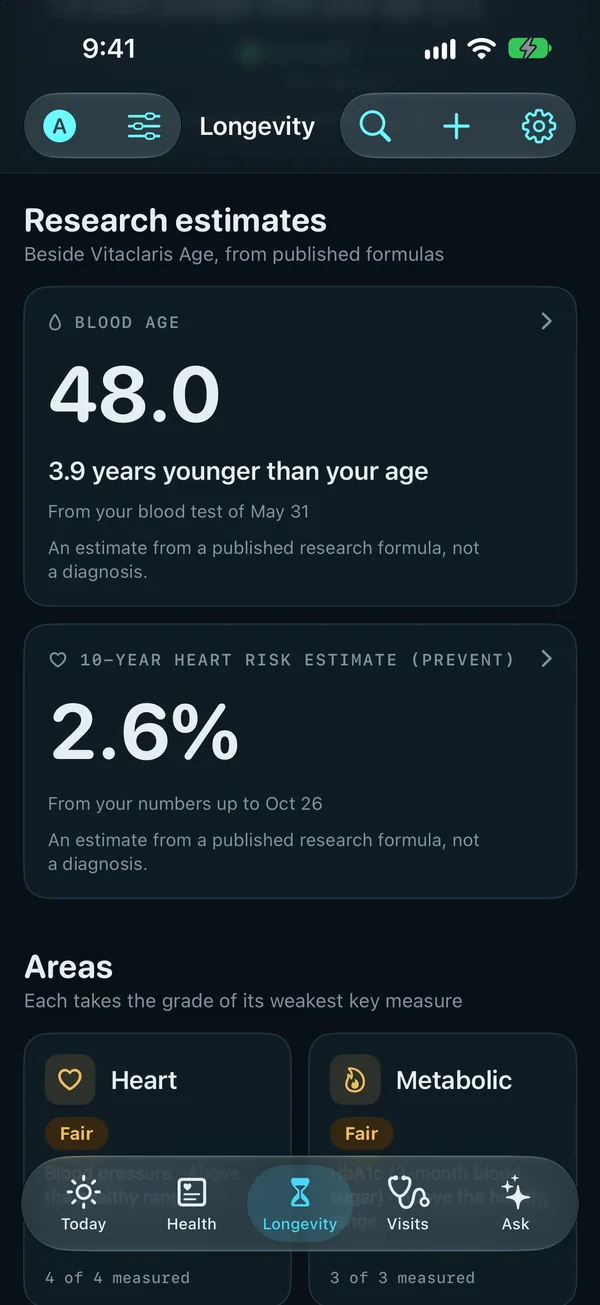
Blood age and your heart risk
Two more estimates from published research, next to your Vitaclaris Age, from results you already have.
- Blood age An estimate from a published research formula (PhenoAge) that uses nine routine blood values, such as albumin, glucose and white blood cells, and your age, with your pace over time. The formula was built on US adults; Vitaclaris works it out from 20 to 100.
- 10-year heart risk estimate (PREVENT) From the PREVENT equations, with your blood pressure, cholesterol, kidney function, blood sugar and smoking, and ApoB, Lp(a) and a calcium score as context. They were made for ages 30 to 79 without a past heart or blood vessel problem, so Vitaclaris works them out only then; plaque or calcium seen only on a scan doesn't stop it.
These are estimates from research formulas, not medical tests, and they name no condition. Ask your doctor what they mean for you; the details for your doctor go in your medical summary.
Check-ins and short tests
Your watch, ring and lab reports fill in most measures by themselves. For the rest, a few questions or a minute on your feet.
- Mood9 questions
- Anxiety7 questions
- Mediterranean diet14 questions
- Smoking and alcohol2 questions
- Screenings and vaccinesWhat's due for your age and sex
- One-leg balance10 seconds, up to 3 tries
- Chair standAs many as you can in 30 seconds
Mood and anxiety check-ins can be saved to the Health app from Apple, like its own. If an answer shows you're going through a hard time, Vitaclaris shows help lines where you live right away.
Bring it to your doctor
Share your Longevity scorecard as a PDF, or find it in the agenda Vitaclaris prepares for each visit, in English or Spanish.
What to do next
Your priorities, ranked by the healthy years each change is linked with, so you know where to start.
- Screenings and follow-ups that are due come first.
- Then the measures with the most room to improve, like LDL, HbA1c or blood pressure, each with its aim, where it is now and about how many years it's linked with.
- Start here marks the first step, and With your doctor the ones to talk over.
- Claude turns them into a plan: how to start each one.*1
Your plan
Vitaclaris Age's steps, screenings due, labs to ask for, visit follow-ups and your programs' targets, in one list, in order. With Vitaclaris Plus, Explain my plan puts it in plain words.